
Solo Wax Play: How to Try It on Your Own for the First Time

Solo wax play is more common than most guides acknowledge. The majority of wax play content assumes two people, a pourer and a receiver, negotiating boundaries and taking turns. That framework matters — and our couples guide covers it thoroughly — but it excludes everyone who is curious, single, or simply wants to understand the sensation before involving someone else.
Trying wax play alone is not a lesser version of the partnered experience. It is a different experience with its own advantages. You control the temperature, the distance, the pace, and the body area. You get unfiltered feedback from your own skin without the added layer of communicating with another person in real time. You can stop, start, experiment, and adjust without worrying about interrupting someone else's rhythm or disappointing expectations.
From a sexological perspective, solo sensory exploration is one of the most effective ways to develop body awareness. Knowing how your skin responds to warmth, where you are more sensitive, and what kind of pacing feels good to you — that knowledge does not expire. If you later share wax play with a partner, you arrive with first-hand understanding rather than guesswork. And if you never do, you still had an experience worth having on its own terms.
This guide covers the practical side: setup, body areas, temperature, technique, aftercare, and the emotional texture of doing something intimate with yourself. If you need the technical foundations first, our beginner's guide covers safety protocols and temperature mechanics. If you want to understand the body map before you start, the body map guide explains which zones suit different experience levels.
Why Solo Wax Play Is Worth Trying
There are three reasons solo wax play works particularly well as a starting point, and none of them require justification or apology.
First, it removes social pressure. Partnered wax play carries a layer of performance — even when both people are careful to avoid it. There is an audience. There is a dynamic. There is someone watching you react for the first time. Solo play removes that audience entirely. Your first flinch, your first surprised laugh, your first "oh, that is actually lovely" — these belong to you. That privacy makes the learning curve feel lighter and more honest.
Second, it builds calibration. When you pour wax on your own forearm, you learn — in seconds — how distance changes intensity. You learn how quickly wax cools. You learn how much a five-degree temperature difference matters. That kind of physical calibration cannot be taught through words. It has to be felt. And once you have felt it, every future session, solo or partnered, benefits from the knowledge.
Third, it can be a form of self-care. This is the part that surprises people most. Wax play at low temperatures is warm, structured, and focused. It asks you to pay attention to your body. It gives you a clear sensory stimulus in exchange for that attention. For some people, a 15-minute solo wax session at 50°C, with soft lighting and no phone, does the same nervous-system work as a long bath or a body scan meditation. It is not inherently sexual. It can be, but it does not have to be. That range is part of what makes solo wax play interesting.
Setting Up for a Solo Session
Solo setup is simpler than partnered setup because you only need to manage one perspective. Here is the streamlined checklist:
Surface and space
- Lay a dark towel on a flat surface — bed, floor, or couch. This catches stray wax and protects your environment.
- Make sure the room is warm enough that bare skin feels comfortable. Being cold before you start tightens muscles and makes sensation feel sharper than it would otherwise.
- Place water within reach. Not because wax play is dangerous, but because having water nearby is a good habit for any self-care ritual involving heat.
- Phone on silent or in another room. Solo wax play works best when your attention is not split.
Candle and position
- Choose a 50°C or 55°C candle. Solo play means you are both pourer and receiver, which limits your range of motion. Lower temperatures give you more forgiveness for imperfect angles.
- Light the candle and let it pool for 2–3 minutes before pouring. A proper wax pool gives consistent, predictable pours.
- Sit upright or recline at an angle. Do not lie flat on your back while pouring on yourself — it limits visibility and control. A seated or semi-reclined position keeps your pouring hand steady and your target area in view.
Skin preparation
- Clean, dry skin gives the cleanest peel. No lotions or oils before the session — they can change how heat interacts with skin.
- If you have thick body hair on the area you plan to pour on, know that wax removal will take slightly longer. Consider trimming if comfort matters to you, but it is not required.
The entire setup takes under five minutes. If you find yourself spending significantly longer, you are probably overthinking it. The preparation for a first solo session should feel no more complicated than drawing a bath.
Best Body Areas for Solo Wax Play
Solo wax play has a practical constraint that partnered play does not: you need to be able to reach the area comfortably while holding a candle. This rules out most of the back, which is the gold-standard zone for partnered sessions. Fortunately, several excellent areas are within easy solo reach.
Inner forearm
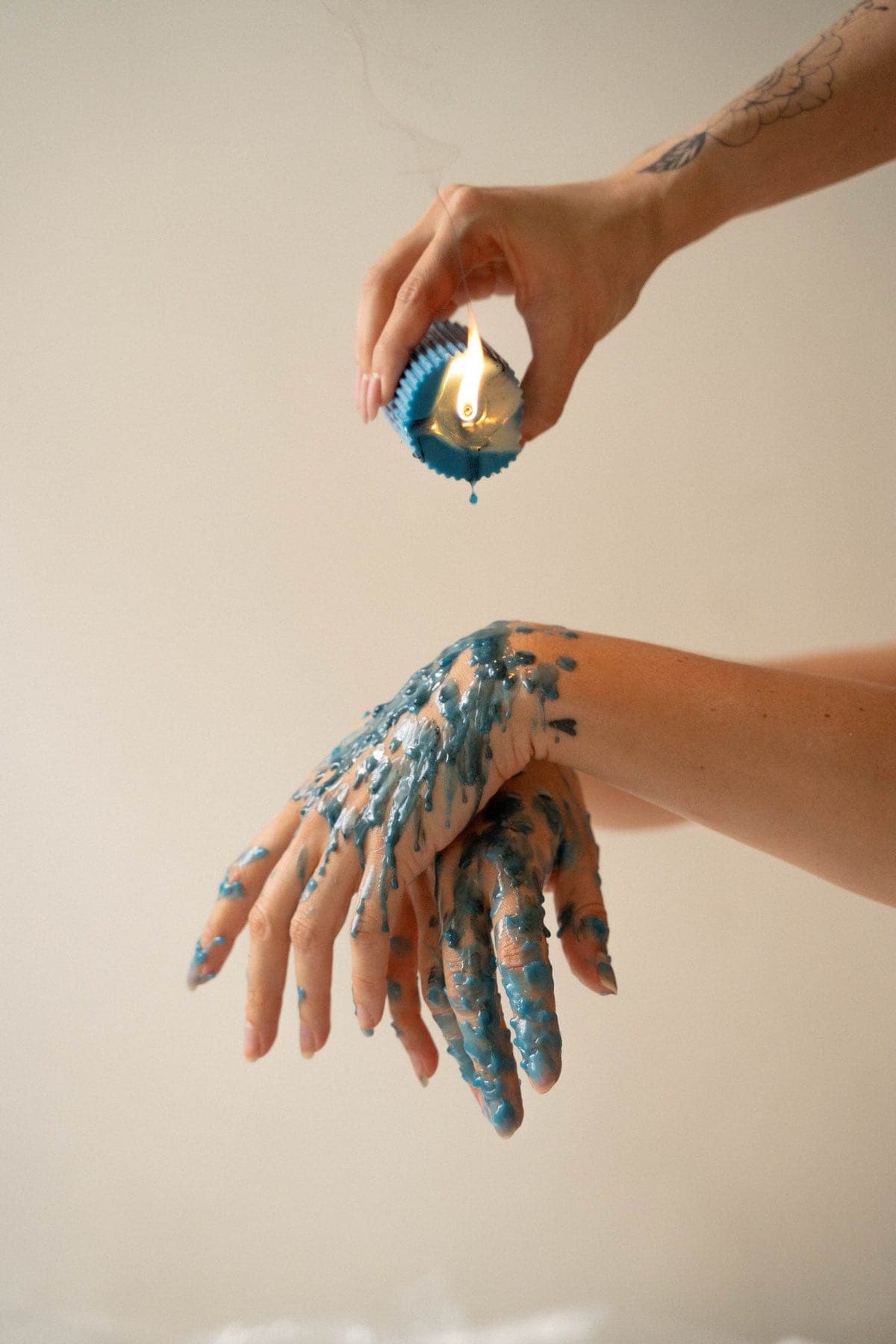
The inner forearm is the best introductory zone for solo play. Rest your non-dominant arm on the towel, palm up, and pour with your dominant hand. The forearm gives you a clear view of the wax as it lands, immediate tactile feedback, and full control over timing. It is also where most candle-makers (including Olga) test their own formulas, so there is a certain poetry in starting where the product itself was first proven safe. The inner forearm is an amber zone — thinner skin, higher sensitivity — but at 50–55°C, it feels comfortably warm rather than intense.
Outer thigh
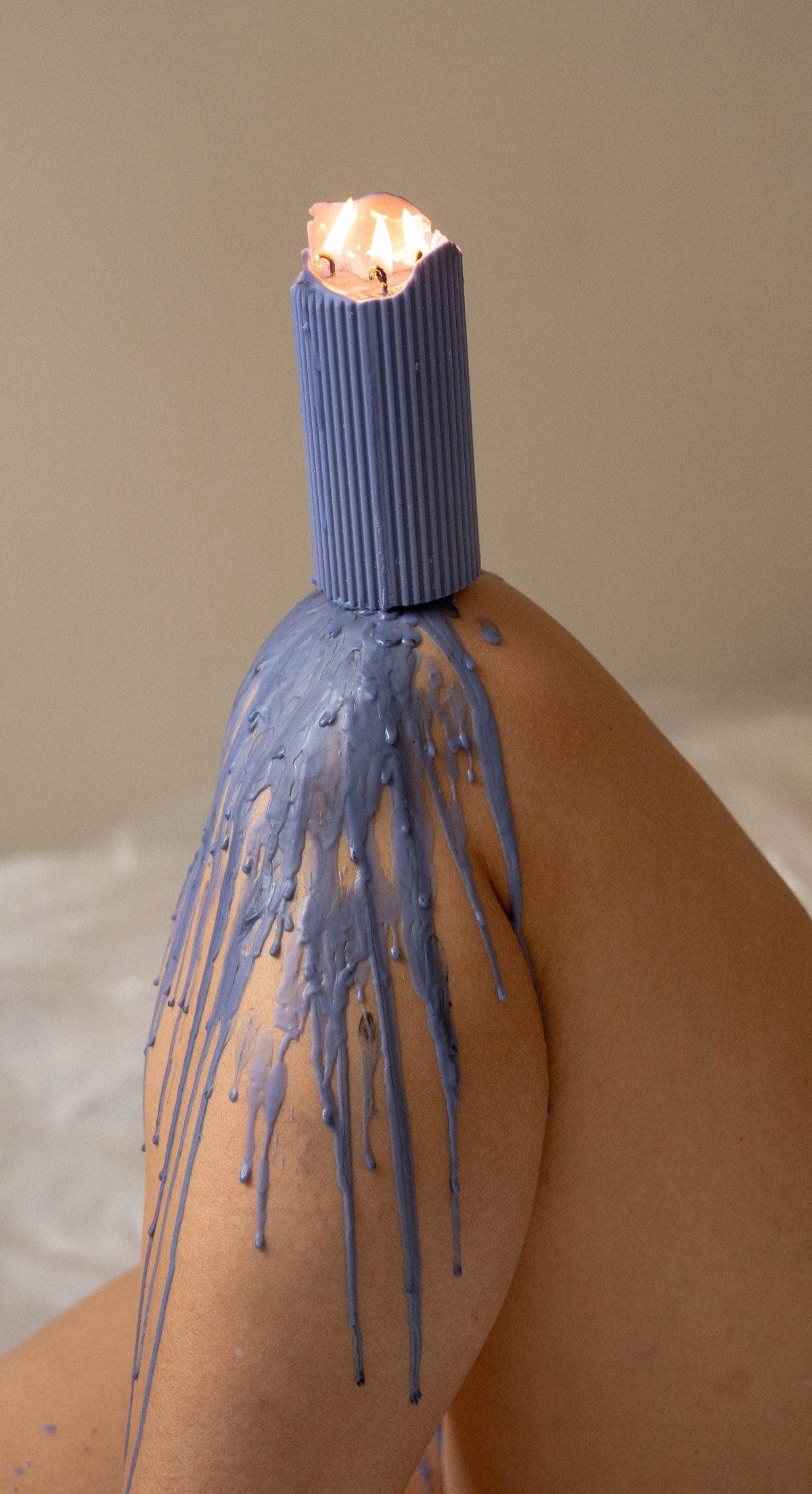
Sit on the edge of a bed or recline on your side. The outer thigh has thick skin, ample padding, and low nerve density — a textbook green zone. It handles even moderate temperatures well and provides a large canvas for patterns, lines, or scattered drops. For solo players, the outer thigh is often where the experience shifts from "testing" to "actually enjoying." The area is forgiving enough that you can stop thinking about technique and start noticing how the warmth feels.
Abdomen (above the navel)
The upper abdomen is accessible from a reclined position and provides a different sensation profile than the forearm or thigh. The skin is thinner and the response is sharper — which can be interesting for people who found the forearm and thigh too gentle. Start with a single drop from high distance to calibrate before committing to more. The lower abdomen is more sensitive and best saved for a second or third session once you understand your own body map.
Upper chest (sternum area)
For people without or with smaller breasts, the sternum area offers a bony, thin-skinned zone that reads temperature quite intensely. This is amber territory. If you want to feel a real distinction between 50°C and 55°C with minimal wax, the sternum will show you. One drop at maximum height is enough to learn. This area is not for warm-fuzzy comfort — it is for people who want precise, sharp feedback about what a candle actually does.
Areas to avoid solo
Skip anywhere you cannot see clearly while pouring, any area near the face, and any zone that requires awkward contortion to reach. If the position feels strained, the pour will be imprecise. The goal of solo wax play is controlled exploration, not acrobatics.
Your First Solo Session, Step by Step
1. Light the candle and wait
Let the wax pool form properly — two to three minutes is enough for most SenseMe candles. Use this time to settle into the moment. Breathe. Notice the scent filling the room. This is not wasted time. It is the transition between your regular state and the focused attention the session asks for.
2. Start with one drop on the inner forearm
Hold the candle 30–40 centimetres above your forearm. Tilt gently until a single drop falls. Watch it land. Feel it. Notice what happens — the initial warmth, the brief peak, the rapid cooling, the solid texture as it sets. That is the entire cycle compressed into two seconds. If it felt comfortable, your candle and distance are calibrated. If it felt too warm, raise the candle higher next time.
3. Pour three more drops, spacing them out
After the calibration drop, pour three more with deliberate pauses between each. Notice whether the second drop feels different from the first. For most people, it does — not because the temperature changed, but because your nervous system is now paying attention. The sensation sharpens slightly with focus. That is normal and desirable.
4. Move to the outer thigh
Once the forearm feels familiar, shift to the outer thigh. Pour from the same height. The sensation will feel different — broader, softer, more absorbed by the muscle underneath. That contrast between forearm and thigh is your body teaching you what the body map means in practice.
5. Experiment with distance
Try one pour from maximum height and another from half that distance. The same candle, the same wax — but the warmth on arrival is noticeably different. Higher = cooler drops, more scattered. Lower = warmer streams, more focused. This is the fundamental variable of wax play technique, and solo sessions are the best place to learn it because there is no pressure to perform while you calibrate.
6. End when curiosity shifts to satisfaction
There is no minimum session length. A meaningful solo session can be five minutes. The natural ending is when you feel complete — when the curiosity that started the session has been answered for now. Do not push past that point looking for something "bigger." The best first sessions end with desire we could define as appetite: "I'd like to do that again, maybe a little differently." That appetite is worth more than a single marathon session.
Self-Aftercare: What to Do After a Solo Session
Aftercare is not only a partnered concept. Your nervous system went through a thermal and sensory cycle. It deserves a few minutes of transition, even if the session was gentle.
- Peel the wax slowly. Let it cool fully, then lift an edge and peel. At 50–55°C, the wax usually comes off in satisfying, clean pieces. If you poured on your forearm, peeling is part of the experience — most people find it oddly pleasurable.
- Wipe with a warm cloth. A warm, damp cloth removes any residual film and feels soothing on skin that just experienced heat. For detailed cleanup instructions, see our removal guide.
- Moisturise if you like. A light, fragrance-free moisturiser or coconut oil helps the skin settle. This is optional but pleasant.
- Take a few quiet minutes. Put the towel aside, blow out any remaining ambience, and sit with how you feel. Not to judge the experience — just to notice it. Did it feel calming? Exciting? Strange? Simpler than expected? All of those reactions are data for next time.
Our full aftercare guide covers skin recovery in more detail, including redness, care for sensitive skin, and what is normal versus what deserves attention.
The Emotional Side of Solo Wax Play
Some people feel a quiet sense of accomplishment after a first solo session. Some feel surprised by how undramatic it was. Some feel a deep calm they did not expect. And some feel oddly emotional — not sad, just moved. All of these responses are normal.
Solo wax play asks you to pay close attention to your own body for an extended period. For many people, that is a rare experience. We are used to tuning our bodies out, not in. When you deliberately create a sensation, track it, respond to it, and choose what to do next based on how it feels — that is a form of somatic intimacy. It can land with emotional weight, especially the first time.
If that happens, do not pathologise it. Sit with it. Write a note if that helps. And know that a practice which creates that kind of internal connection is probably worth returning to.
If the emotional response feels overwhelming or uncomfortable, step back and treat it like you would any intense self-care moment — water, warmth, and gentleness with yourself. That is aftercare too.
Start with yourself
A single beginner candle, a towel, and fifteen minutes. Solo wax play does not need more than that to be worth trying.
Explore CollectionSolo Wax Play FAQ
How long should a solo wax play session last?
Is it weird to do wax play alone?
What temperature candle for solo wax play?
Where should you pour wax during solo wax play?
Keep exploring
- Article
Couples Guide
Intro — acknowledges the partnered context without assuming it.
- Guide
Beginner'S Guide
Intro — foundational reference for safety and temperature mechanics.
- Article
Body Map Guide
Intro and body areas section — companion reference for zone classification.
- Article
Removal Guide
Aftercare section — detailed cleanup methods.
- Article
Aftercare Guide
Aftercare section — skin recovery and redness guidance.