
Intimacy Exercises for CouplesSensation-Based Practices That Actually Work
Most intimacy advice is either too vague to follow or too awkward to try. These seven exercises are specific, structured, and grounded in the neuroscience of touch and temperature. They do not require you to be spontaneous. They require you to show up.

Key Takeaways
- These exercises are ordered from gentle to intense. Start with #1 (eye contact, no touch) and work through at your own pace. You do not need to do all seven. You need to find the one that resonates and repeat it.
- Each exercise is self-contained — you can do any one of them as a standalone practice in 10–30 minutes.
- The exercises are built on neuroscience: C-tactile afferent activation, oxytocin release, parasympathetic shifts through warmth, and attention as a sensation amplifier.
- None of these exercises are explicitly sexual. They target the sensory and emotional systems that support intimacy, not sexual performance. Some may naturally lead to sexual connection; others will not. Both outcomes are fine.
- Ritual beats novelty. Repeating the same exercise weekly produces deeper results than trying a different exercise every time. The nervous system bonds through reliability, not surprise.
Intimacy exercises for couples fill the internet, and most of them are useless. "Look into each other's eyes" with no further instruction. "Try something new in the bedroom" without saying what. "Schedule a date night" as if the calendar is the problem. The advice is vague because the underlying model is vague: the assumption is that intimacy is a mood that the right setting will produce, rather than a physiological state that specific, structured practices can reliably activate.
This guide takes the opposite approach. Each exercise has a specific neurological target: oxytocin release, parasympathetic activation, C-tactile engagement, attentional amplification, or nervous-system co-regulation. Each exercise has step-by-step instructions that require no interpretation. Each takes 10–30 minutes. And each has been used in practice — I am Olga Bevz, a sexologist, and I have facilitated these exercises with couples in clinical and workshop settings for years. They work, they are repeatable, and they do not require spontaneity, wine, or a weekend away.
The exercises are ordered from least to most intense. Start where you feel comfortable. When one exercise becomes familiar, it becomes deeper — not stale. Repetition is the mechanism, not the enemy.
Why Generic Intimacy Advice Does Not Work
Three structural reasons:
It targets the wrong system. Most advice targets the cognitive system: "communicate better," "be more present," "show appreciation." These are good things, but they do not directly activate the body's bonding circuitry. Intimacy is not only a thought — it is a physiological state mediated by oxytocin, parasympathetic tone, and synchronized nervous-system activity. If you only work on the cognitive level, you are addressing the story of intimacy without changing the body's experience of it.
It lacks specificity. "Touch more" is not an instruction. How fast, how firm, where, for how long, with what attention, in what sequence? Without specificity, couples default to whatever they already do — which, if they are seeking advice, is not working. Specificity is not rigidity. It is scaffolding that gives the nervous system something concrete to respond to.
It assumes novelty is the answer. Long-term relationships do not fail from insufficient novelty. They fail from insufficient attention. A new restaurant does not reactivate the bonding system. A familiar touch, delivered slowly and deliberately, does. The nervous system produces oxytocin in response to reliable, repeated, predictable closeness — not surprise. Building a practice around repetition is neurologically superior to building one around variety.
The Sensation-Based Approach
These exercises work by directly engaging the body's sensory and bonding systems through three channels:
- Touch — slow, deliberate, skin-to-skin contact that activates C-tactile afferent fibers and triggers oxytocin release in both partners.
- Temperature — warmth applied through hands, oil, or body-safe wax that activates the parasympathetic nervous system and produces safety signals.
- Attention — focused, unhurried awareness of sensation that amplifies the neural response to whatever is happening at the skin level.
Each exercise emphasizes one or more of these channels. None require special equipment (though exercises 4, 6, and 7 use warm oil or candles, which improve the experience). All require only what you already have: a body, a partner, and twenty minutes of undivided attention.
7 Exercises (From Gentle to Intense)
1. Three-Minute Eye Contact (No Touch)
Time: 3 minutes
Channel: attention only
What it targets: social-attention activation, vagal tone, baseline co-regulation
Instructions:
- Sit facing each other. Cross-legged on the floor or in chairs, knees almost touching. Same eye level.
- Set a timer for three minutes. Close your eyes for three breaths to settle.
- Open your eyes and look into your partner's left eye (picking one eye reduces the visual "searching" that makes prolonged gaze uncomfortable).
- Hold the gaze. You will feel an urge to look away, laugh, or break the tension. That urge is your nervous system recalibrating — it is the exercise working, not a sign you should stop.
- Breathe normally. Do not speak. Let whatever arises — amusement, tenderness, discomfort, tears — arise without commentary.
- When the timer sounds, close your eyes for three breaths before speaking.
Why it works: sustained gaze activates the ventral vagal circuit (Porges' polyvagal theory), increases oxytocin, and begins nervous-system synchronization before any touch occurs. It is the lowest-barrier exercise on this list and often the most surprisingly powerful.
2. Breath Synchronization
Time: 5 minutes
Channel: attention + proximity
What it targets: heart-rate variability synchronization, parasympathetic co-regulation
Instructions:
- One partner lies on their back. The other lies beside them, close enough that bodies touch along one side.
- The lying-down partner places one hand on their own chest. The other partner places one hand on the first partner's chest, next to their hand.
- The first partner breathes naturally. The second partner adjusts their breathing to match — same rhythm, same depth, same pace.
- Stay here for five minutes. The synchronization will become effortless after about ninety seconds.
- Switch roles.
Why it works: respiratory synchronization is one of the body's primary co-regulation mechanisms. When two nervous systems breathe in sync, heart-rate variability aligns and both systems shift toward parasympathetic dominance. This exercise is especially effective for couples who feel emotionally disconnected — the bodies reconnect before the minds catch up.
3. Guided Touch Exploration (Hands Only)
Time: 10 minutes (5 per partner)
Channel: touch + attention
What it targets: C-tactile afferent activation, oxytocin, rediscovering touch as deliberate rather than habitual
Instructions:
- One partner extends both hands, palms up. The other partner explores them — slowly, attentively, with full focus on sensation rather than conversation.
- Trace the lines of the palm. Feel the difference between the pad of the thumb and the back of the hand. Notice temperature, texture, the tiny movements your partner makes in response.
- Speed: approximately 3 cm per second. Slow enough that both of you can feel each millimeter of contact.
- No talking during the exploration. Five minutes per partner. Switch roles when the timer sounds.
- After both rounds, share one observation each. Not an evaluation — just something you noticed.
Why it works: hands are one of the most densely innervated areas of the body. Slow, deliberate touch at C-tactile optimal speed turns a familiar body part into a rich sensory landscape. Couples who have been together for years regularly report discovering things about their partner's hands they never noticed.
4. Temperature Contrast Ritual
Time: 15 minutes
Channel: touch + temperature + attention
What it targets: thermoreceptor activation, parasympathetic shift, heightened sensory awareness through contrast
What you need: warm oil (jojoba or sweet almond, warmed between hands), a cool object (a metal spoon from the fridge, a smooth stone, or an ice cube wrapped in cloth)
Instructions:
- One partner lies face-down on a comfortable surface. The room should be warm.
- Warm a small amount of oil between your palms until it reaches body temperature or slightly above.
- Apply the oil to your partner's upper back in slow, broad strokes (3 cm/s). Continue for three minutes — long enough for the nervous system to settle into the warmth.
- Without warning, place the cool object briefly on the warmed skin — between the shoulder blades, on the back of the neck, or along the spine. Hold for 3–5 seconds. Remove.
- Return immediately to warm oil strokes. Notice how the warmth feels different after the contrast — sharper, more vivid, more present.
- Repeat the contrast 2–3 more times, varying the location. End on warmth.
- Cover your partner with a warm blanket for a few minutes before switching roles.
Why it works: warm-cold contrast rapidly switches between parasympathetic and sympathetic activation, keeping the nervous system in a state of heightened attentiveness. The return to warmth after cold produces a deeper parasympathetic shift than warmth alone — the body relaxes more completely because it has something to relax from.
5. Blindfold Sensory Focus
Time: 15 minutes
Channel: touch + attention (amplified by removing visual input)
What it targets: sensory amplification through deprivation, trust, attentional narrowing
What you need: a soft blindfold or sleep mask
Instructions:
- One partner puts on the blindfold. The other guides them to a comfortable seated or lying position.
- The sighted partner has one rule: do not ask permission for each touch, but do move slowly and predictably. No surprises. The point is to amplify sensation, not to startle.
- Begin with fingertip contact only: trace the outline of the jaw, the ridge of the collarbone, the inside of the wrist, the curve of the ear. Spend time in each area rather than moving rapidly.
- After five minutes of fingertip touch, switch to full-hand contact: palm on chest, hand encircling the forearm, both hands on the face.
- After ten minutes total, place both hands on your partner's shoulders and hold still for thirty seconds. This signals the transition.
- Remove the blindfold slowly. Let your partner's eyes adjust before speaking.
- Switch roles.
Why it works: removing visual input forces the brain to allocate more processing resources to remaining senses. Touch sensitivity increases measurably when vision is occluded. The result is that ordinary, familiar touch feels intensified — not because the touch changed, but because the brain is listening harder. This exercise also builds trust: allowing someone to control your sensory environment is a vulnerability that, when held well, deepens the attachment bond.
6. Shared Wax Play Session
Time: 20–30 minutes
Channel: touch + temperature + attention (compound)
What it targets: full sensory engagement, endorphin release, structured vulnerability, trust
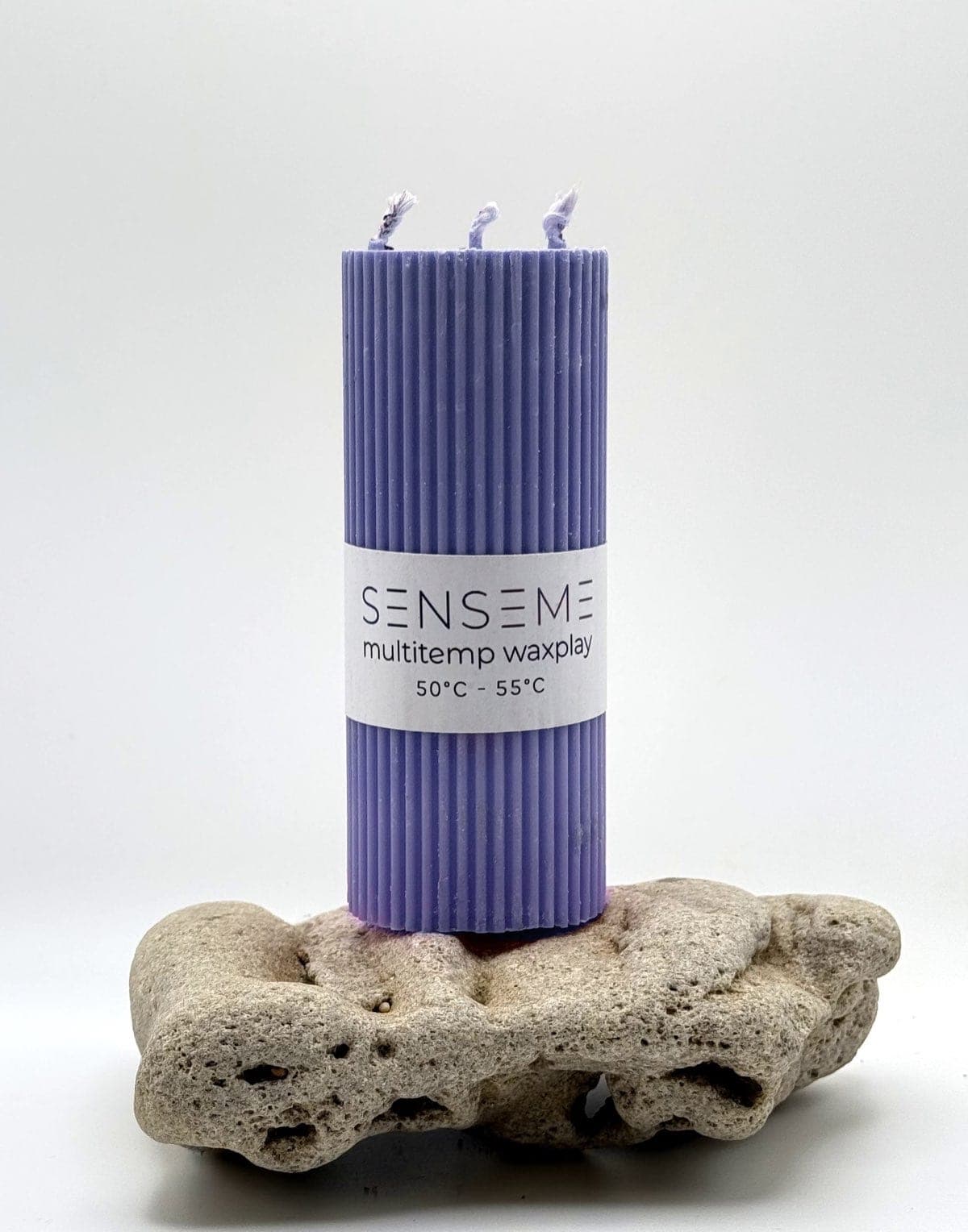
What you need: a body-safe wax play candle (50–55°C for beginners), a soft towel or sheet, warm oil for aftercare
Instructions:
- Prepare the space: warm room, soft lighting, a protected surface, aftercare supplies within reach. Light the candle 15–20 minutes before you begin.
- One partner lies comfortably. The other holds the candle 30–40 cm above the receiving partner's skin.
- Begin with a single drop on the forearm — a patch test and an introduction. Wait. Watch your partner's response. Ask: "How does that feel?"
- If the response is positive, move to broader areas: upper back, chest, thighs. Pour in slow, deliberate lines — not drips but thin streams that trace the body's contours.
- Between pours, touch the skin where the wax has cooled. The contrast between warm wax and cool fingers creates a layered sensory conversation.
- After the session, peel the cooled wax gently. Apply warm oil to the skin using slow strokes. This is aftercare — and it is part of the exercise, not an add-on.
- Wrap your partner in a blanket. Stay close. Be unhurried.
Why it works: wax play simultaneously engages mechanoreceptors (the physical landing), thermoreceptors (the warmth), and the attentional system (the ritual, the anticipation, the pacing). This compound sensory event produces a cascade of oxytocin, endorphins, and parasympathetic activation that single-channel exercises do not match. For a full introduction, see our wax play beginners guide.
7. Full Sensory Date Night (Combined Practice)
Time: 60–90 minutes
Channel: all three, sequenced
What it targets: deep co-regulation, sustained oxytocin elevation, ritual bonding
What you need: warm oil, a body-safe candle, a blindfold, a warm blanket, water, a snack, a grounding playlist
Instructions:
- Opening (10 min): three-minute eye contact (#1), then breath synchronization (#2). This grounds both nervous systems before any touch begins.
- Exploration (15 min): guided touch exploration (#3) — hands only, then expanding to forearms, neck, and face. Slow. Quiet.
- Temperature (15 min): warm oil massage with contrast (#4). One partner gives, then switches. Or: one partner receives for the full fifteen minutes if the focus is on depth rather than balance.
- Intensity (20 min): shared wax play session (#6) or blindfold exercise (#5), whichever resonates. This is the peak of the arc.
- Landing (15–20 min): full aftercare. Water, warmth, blanket, snack, skin care if wax was used. No phones. No conversation about the experience — just presence. Let the bodies settle.
- Integration (next day): check in. "How do you feel today? What stood out? What would you do differently?" This conversation turns a single evening into a practice.
Why it works: sequencing the exercises from least to most intense follows the natural arc of nervous-system engagement: grounding → building → peaking → landing. This arc mirrors how the autonomic nervous system wants to move through intensity — gradually up, with a clear top, and a slow descent. Rushing or skipping the arc produces a less satisfying experience and a harder recovery.
How to Choose Which Exercise to Start With
- If you have not touched deliberately in a while: start with #1 (eye contact) or #3 (hand exploration). No equipment, no risk, low barrier. Build from there.
- If touch feels awkward or strained: start with #2 (breath synchronization). It uses proximity without requiring active touch, which gives both nervous systems time to re-learn safety before touch begins.
- If you want to add something new: #4 (temperature contrast) is a natural entry point. Warm oil requires nothing you do not already own, and the contrast element creates novelty within structure.
- If you are experienced with sensation and want depth: go directly to #6 (wax play) or #7 (full sensory date night). You already have the relational infrastructure to hold a more intense practice.
- If you do not know: start with #1. Three minutes, zero equipment, zero risk. See what it stirs. Everything else follows.
The Conversation Before and After
Every exercise benefits from a brief conversation before ("what are we doing, and what do each of us need?") and after ("what did you notice?"). This is not therapy. It is calibration.
Before: "I want to try exercise [number] tonight. It takes about [time]. Here is what we will do. Is there anything you want to adjust before we start?" That is the whole pre-conversation. It takes sixty seconds and prevents ninety percent of awkwardness.
After: not immediately after — wait at least thirty minutes, or until the next day. Then: "What stood out for you? Was anything surprising? Is there anything you would want more of, less of, or different next time?" These questions turn a single practice into an iterative one. Over weeks and months, they build a shared vocabulary for physical intimacy that is specific to your partnership.
For a deeper negotiation framework — especially useful for exercises #5, #6, and #7 — see our aftercare negotiation guide.
Further Reading
- How Touch Changes the Body: A Sexologist's Guide to Sensory Intimacy
- Oxytocin and Touch: The Biology of Bonding, Trust, and Connection
- Temperature and the Nervous System: Why Warmth Changes How You Feel
- Touch Hunger: What Happens When the Body Does Not Get Enough Physical Contact
- Wax Play for Beginners: Your Complete First-Session Guide
- BDSM Aftercare: The Complete Guide to Recovery After a Scene
- How to Negotiate Aftercare Before a Scene
- Wax Play for Couples: How to Bring It Up and Where to Start
Sources & References
- McGlone, F., Wessberg, J., & Olausson, H. (2014). Discriminative and Affective Touch: Sensing and Feeling. Neuron, 82(4), 737–755.
- Carter, C. S. (2014). Oxytocin Pathways and the Evolution of Human Behavior. Annual Review of Psychology, 65, 17–39.
- Porges, S. W. (2011). The Polyvagal Theory: Neurophysiological Foundations of Emotions, Attachment, Communication, and Self-Regulation. Norton.
- Gottman, J. M., & Silver, N. (2015). The Seven Principles for Making Marriage Work (2nd ed.). Harmony Books. — Framework for relational bids and repair cycles relevant to exercise design.
- Jakubiak, B. K., & Feeney, B. C. (2017). Affectionate Touch to Promote Relational, Psychological, and Physical Well-Being in Adulthood. Personality and Social Psychology Review, 21(3), 228–252.
This article is for educational purposes and does not constitute medical, psychological, or therapeutic advice. These exercises are designed for consenting adult partners. If you or your partner have a history of touch aversion, trauma, or difficulty with physical intimacy, consider working with a somatic therapist or sexologist before beginning a structured touch practice.
Frequently Asked Questions
Are these exercises sexual?
Can these exercises help after a long period without physical intimacy?
Do these exercises replace therapy for couples?
Do we need special equipment for these exercises?
How often should couples do intimacy exercises?
What if my partner is not interested in intimacy exercises?
What is the best exercise to start with?
Olga Bevz
Olga studies how the body processes sensation in intimate contexts. She founded SenseMe to build tools — specifically temperature-controlled body-safe candles — for people who want to use that science intentionally. She writes about touch, temperature, nervous-system regulation, and the quiet skills that make intense experiences land well.
Read full story