Sensory MappingHow to Discover What Your Body Actually Responds To
Most people have never systematically explored how their own body responds to sensation. The result is a relationship with the body built entirely on guesses. Sensory mapping is a structured practice for replacing those guesses with data — with specific information about where you are sensitive, what kind of sensitivity it is, and how that sensitivity changes with context.

Key Takeaways
- Sensory sensitivity is not uniform across the body. Nerve density varies by a factor of ten or more between body regions — fingertips have more than a hundred mechanoreceptors per square centimeter; the back has fewer than ten. Skin thickness, blood flow, and local anatomy further shape how touch, temperature, and pressure register. The classic somatosensory homunculus — the brain's distorted map of the body surface — reflects these real differences in sensitivity.
- Sensitivity is multi-dimensional. An area that is highly sensitive to light touch may be relatively insensitive to pressure. An area that registers temperature intensely may register texture barely at all. Sensory mapping treats touch, temperature, and pressure as independent channels and maps each one separately — because a single "sensitivity" score misses most of what matters.
- Personal variation is large. Standard anatomical maps describe averages. Individual bodies depart from those averages in ways that are sometimes dramatic — a function of genetic variation, injury history, habitual movement patterns, and the emotional associations a given area has accumulated over a life. This is why two partners with similar anatomy can respond very differently to the same touch.
- Mapping is a practice, not a one-time event. Sensitivity shifts with arousal state, stress, menstrual cycle, sleep, and recent touch history. The map is best understood as a moving snapshot. Couples who revisit the practice together every few months build a working knowledge of each other's bodies that accumulates over years.
- Mapping feeds directly into intimate practice. Knowing that a partner has high temperature response on the upper back and low response on the abdomen changes where warm oil, heated wax, and contrast work are most effective. The same applies to pressure-sensitive vs stroke-sensitive areas. Mapping converts intimate practice from guessing to informed design.
Most people have a rough internal picture of their own body's sensitivity — a handful of places they know are responsive, a handful they know are ticklish or numb, and a large area in between that they have never thought about in any structured way. This rough picture is usually wrong in specific, consequential ways. The classic mistake is generalizing from a few memorable experiences ("my neck is sensitive") to a global rule, when in fact neck sensitivity is highly variable across individuals, across the specific location on the neck, and across what kind of sensation is being applied. A person can be extremely responsive to slow stroking along the side of the neck and entirely unresponsive to pressure on the same area — and the difference matters.
Sensory mapping is the practice of replacing the rough internal picture with systematic observation. The idea is old — clinicians have been using variations of it in somatic therapy, sex therapy, and pain medicine for decades — but the everyday application of it is underused. A couple can live together for a decade without ever having sat down to work out, with any deliberateness, where on each other's bodies touch actually lands and what kind of touch lands best there. The information is there to be gathered. It is simply not usually gathered.
I am Olga Bevz, a sexologist. I design tools for intentional sensation, and sensory mapping is the practice that tells people where those tools will do the most work. This guide covers what sensory mapping is, why bodies vary in their responses, a solo protocol and a partnered protocol, how to record what you find, and how the map connects to broader intimate practice. If your interest is specifically wax play safety — where wax can and cannot go — see our companion guide on wax play body map and safe zones; this article is a different kind of map.
What Is Sensory Mapping?
Sensory mapping is a structured practice in which a sequence of defined stimuli — a specific kind of touch, temperature, or pressure — is applied to a defined area of the body, and the response is observed and recorded. It is closer to calibration than to massage. The goal is not to produce a particular experience but to gather information: where on this body does this stimulus produce a strong response, where does it produce a mild response, and where does it produce almost nothing.
The practice treats sensation as multi-dimensional. A region of skin is not simply "sensitive" or "insensitive" — it has separate response profiles for different kinds of input. Three channels are worth mapping independently:
- Light touch and stroke — the slow movement of a fingertip, a feather, or a soft brush across the skin. This channel is carried primarily by C-tactile afferents (affective touch fibers) and by low-threshold mechanoreceptors.
- Pressure — sustained weight or firm contact without movement. This channel engages deeper mechanoreceptors (Pacinian and Ruffini corpuscles) and produces a distinct, often settling response.
- Temperature — warm or cool input delivered to the skin. Handled by a separate set of receptors (TRPV and TRPM channels, covered in our temperature guide), with its own pathway to the brain.
A given body area produces three independent readings — one for each channel — and the pattern matters. Someone with high light-touch response, moderate pressure response, and low temperature response on a given area will have a very different experience of sensation practice on that area than someone with the reverse pattern. Mapping treats this as the default assumption rather than as an edge case.
Why Bodies Respond Differently
Nerve Density Variations
The most basic reason for response variation is straightforward anatomy: the density of sensory nerve endings in the skin differs dramatically between body regions. Fingertips, lips, and tongue have the highest density — more than a hundred mechanoreceptors per square centimeter — which is why fine texture discrimination is best there. The back, the outer thighs, and the backs of the arms have far fewer receptors per unit area. The classic Penfield somatosensory homunculus — the cortical map of the body — shows this distribution inverted: the parts of the brain devoted to fingertips and lips are disproportionately large, while the parts devoted to the back and torso are surprisingly small. The homunculus is not an oddity; it is a faithful representation of where sensory real estate is concentrated.
The practical consequence: a stroke that produces a vivid response on a forearm can produce an almost nothing response on the middle back, not because the back is numb, but because its resolution is lower. The same input, scaled up — a broader stroke, more sustained contact, a temperature component — can produce a strong back response. The area is not insensitive; it is sensitive to different things.
Skin Thickness and Temperature Sensitivity
Skin thickness and blood-flow patterns modulate temperature response independently of touch response. Thin-skinned, well-vascularized areas — the inner wrists, the inner elbows, the inner thighs, the sides of the neck — register thermal input quickly and at low thresholds. Thick-skinned areas with less blood flow — the soles of the feet, the palms in some people, the backs of the hands — register touch clearly but require more intense thermal input to produce the same felt response. This is directly relevant for any temperature-based practice, including warm-oil work and wax play at controlled temperatures: the same 55°C candle produces substantially different sensations on the inner forearm vs the outer thigh, and the difference is skin, not willpower.
Emotional and Psychological Layers
Sensory response is not only anatomy. Areas that have accumulated emotional associations — through injury, through caregiving experiences in early life, through past intimate experiences positive or negative — respond with added layers the raw anatomy does not predict. An area of the body where someone was held as a child may produce disproportionate comfort response as an adult. An area associated with injury or violation may produce flinch or numbness regardless of nerve density. These layers are not obstacles to mapping — they are part of what mapping discovers. The response is the response; the work is to notice it without overriding it.
A Solo Sensory Mapping Practice (Step-by-Step)
Twenty to thirty minutes, alone, in a warm room. Done with the same rigor as mindful touch practice — slow, attentive, recorded — this builds an accurate personal map across weeks.
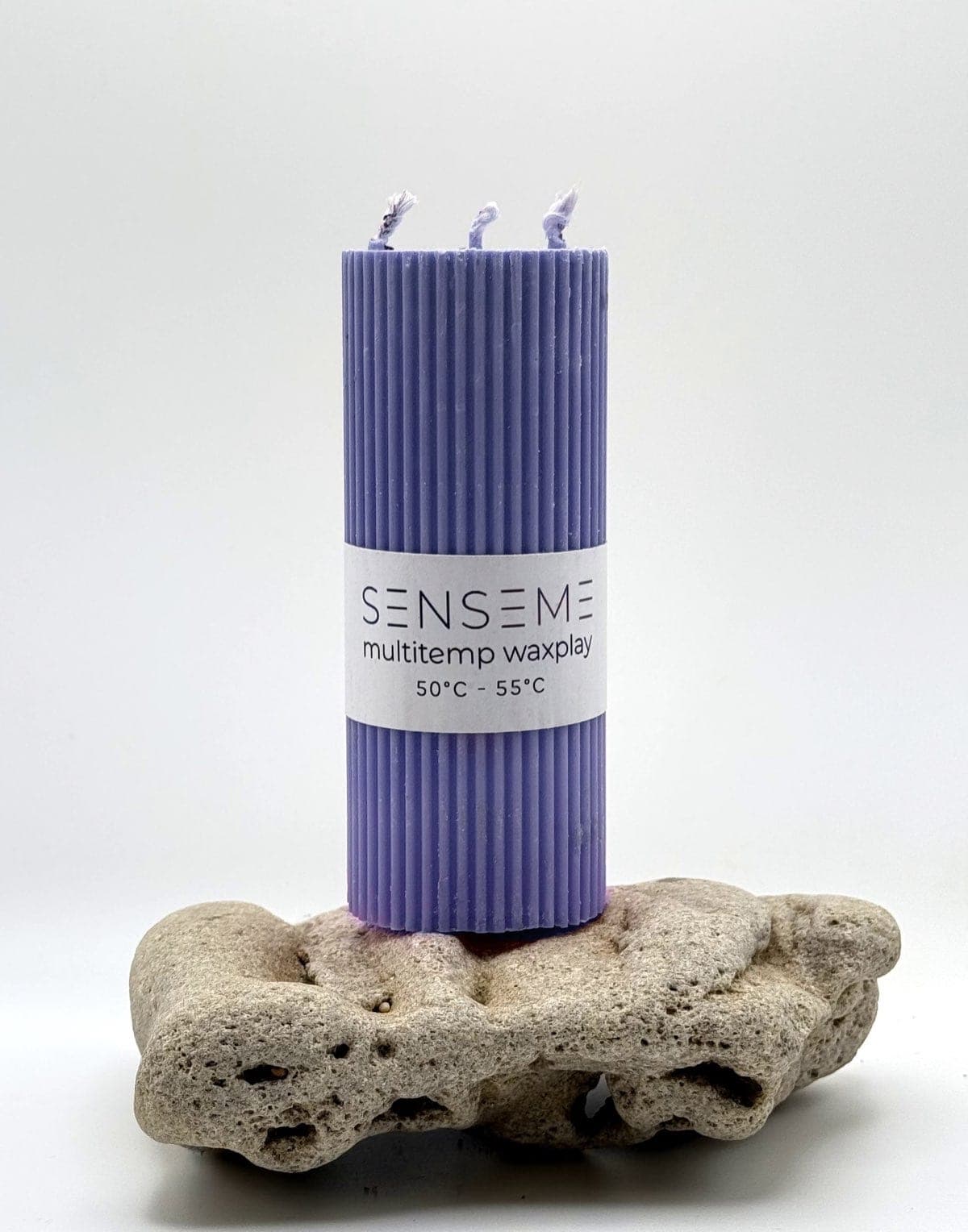
- Gather three tools for three channels. For light touch: a fingertip or a soft-bristled brush. For pressure: the heel of your palm or a small weighted object (a warmed stone, a small beanbag). For temperature: a warm washcloth, a warm ceramic mug, or a body-safe candle at 50–55°C for the more advanced version. Have a notebook or a printed body outline within reach.
- Settle first. Same as mindful touch: warm room, clothing off or loose, thirty-second settling breath. Mapping while activated produces distorted readings — the sympathetic nervous system suppresses fine sensation.
- Work one area at a time, one channel at a time. Start with the forearms. Apply light-touch stroke for thirty seconds — slow, about one inch per second. Notice the response: vivid, moderate, mild, almost nothing. Note it. Then apply pressure to the same area for thirty seconds — firm, sustained, no movement. Note the response. Then apply temperature — a warm cloth, a warm mug, held against the skin for thirty seconds. Note the response. You now have a three-channel reading for that area.
- Move systematically. Forearms → hands and palms → shoulders → neck (sides and back) → chest → ribs and sides → abdomen → lower back → hips → thighs (inner, outer, front, back) → calves → feet. Keep the sequence consistent across sessions so readings are comparable over time.
- Record three readings per area. Simple scale: 3 (vivid, immediate, distinct), 2 (moderate, clearly felt but not striking), 1 (mild, barely noticed), 0 (no response, numbness). Record all three channels. You are building a matrix, not a single score.
- Notice the emotional layer separately. Some areas will produce emotion — comfort, tenderness, discomfort, memory, arousal, flinch — independent of their raw sensitivity rating. Mark these areas with a note. An area that scores 2 on all channels but produces a strong emotional response is information you need; an area that scores 3 across the board but produces flatness is equally informative.
- Close the session. Rest hands on the chest or abdomen for three minutes. Do not stand up immediately. Mapping is more activating than it looks, and the nervous system settles best with a return to stillness before transitioning to other activity.
A Partnered Sensory Mapping Practice (Step-by-Step)
Thirty to forty-five minutes. One partner receives, one partner maps. This is not a simultaneous practice — divided attention produces worse readings on both sides. Switch roles in a later session.
- Negotiate first. Agree on the body areas in scope, the channels to be tested, the signals for pause and stop, and that the practice is non-sexual for the duration. Agree that the map itself — the information produced — will be shared and discussed afterward, and that both partners will respect it going forward. The negotiation is itself a trust-building move; for the underlying mechanism see our guide on vulnerability and trust.
- Set up a recording system. A printed body outline on a clipboard, or a shared note on a phone. The mapper records the readings; the receiver calls them out. This externalizes the data and keeps the practice from collapsing into mood.
- Start with a calibration stroke. Before any mapping, the mapper delivers one test stroke to the inner forearm — a known, sensitive area — at the slow pace the practice will use throughout. The receiver names the sensation in a word or two: warm, tingly, numb, vivid, pleasant, neutral. This calibrates the shared vocabulary for the session. Everyone's "moderate" is different until it has a reference point.
- Map one area at a time, three channels each. Same method as the solo protocol: light touch, pressure, temperature, thirty seconds each, with notes between each application. The mapper reads out the area name before each set; the receiver reports the rating after each channel. The rhythm becomes predictable within a few minutes — area name, touch, number, pressure, number, temperature, number, move on.
- Use the same sensation vocabulary. A shared vocabulary prevents miscommunication. Useful words: vivid, warm, electric, settling, soft, numb, ticklish, pleasant, uncomfortable, heavy, faint. Avoid evaluative words like "good" or "bad" — the map is a description, not a judgment. Areas that are numb or uncomfortable are as important as areas that are vivid.
- Let surprises stand. A partner may discover an area neither of you expected to be sensitive, or an area you both assumed was responsive but actually isn't. This is the whole point of the practice. Write the surprise down. Do not explain it away or adjust the data to match the previous assumption.
- Close with contact and discussion. When the map is complete, the mapper lays both hands on the receiver's chest or abdomen for three to five minutes in silence — co-regulation at the end of the arc. Then review the map together. What surprised you? What confirmed what you already suspected? What do you want to explore next session? The conversation is part of the practice; without it, the map is data without use.
Recording What You Find
Body Map Template
A printed outline of the body — front and back views — with enough room to write three small numbers next to each area and a brief note alongside. The numbers are your three-channel readings (light touch, pressure, temperature); the note captures emotional layer, surprises, or asymmetries. Simple beats elaborate. A photocopied outline with hand-written marks is more useful than a digital system that you will not actually fill in.
Date every map. Sensitivity changes with stress, arousal, menstrual phase, sleep, and recent touch history. A map made during a calm Sunday morning is not the same as a map made at the end of a stressful week, and both readings are valid information about a real body at a real moment. Over time, a folder of dated maps tells you not just where you are sensitive but how your sensitivity moves with context.
Sensation Vocabulary
Descriptive language makes the map legible to a partner and to your future self. A short working vocabulary, grouped by what it captures:
- Intensity: vivid, strong, moderate, mild, faint, absent.
- Quality: warm, cool, electric, heavy, light, buzzing, prickling, throbbing, smooth.
- Valence: pleasant, neutral, uncomfortable. (Separate from intensity — something can be vivid and unpleasant, or mild and deeply pleasant.)
- Emotional register: settling, opening, guarded, tender, memory-evoking, neutral.
Four to five words from this vocabulary next to each reading, written quickly, produces a map richer than a numerical rating alone.
How Mapping Connects to Practice
A completed map is not the end of the work — it is the beginning. The map tells you where specific kinds of input will do the most. From there, practice is the deliberate deployment of what the map reveals.
Temperature Work (Including Wax Play)
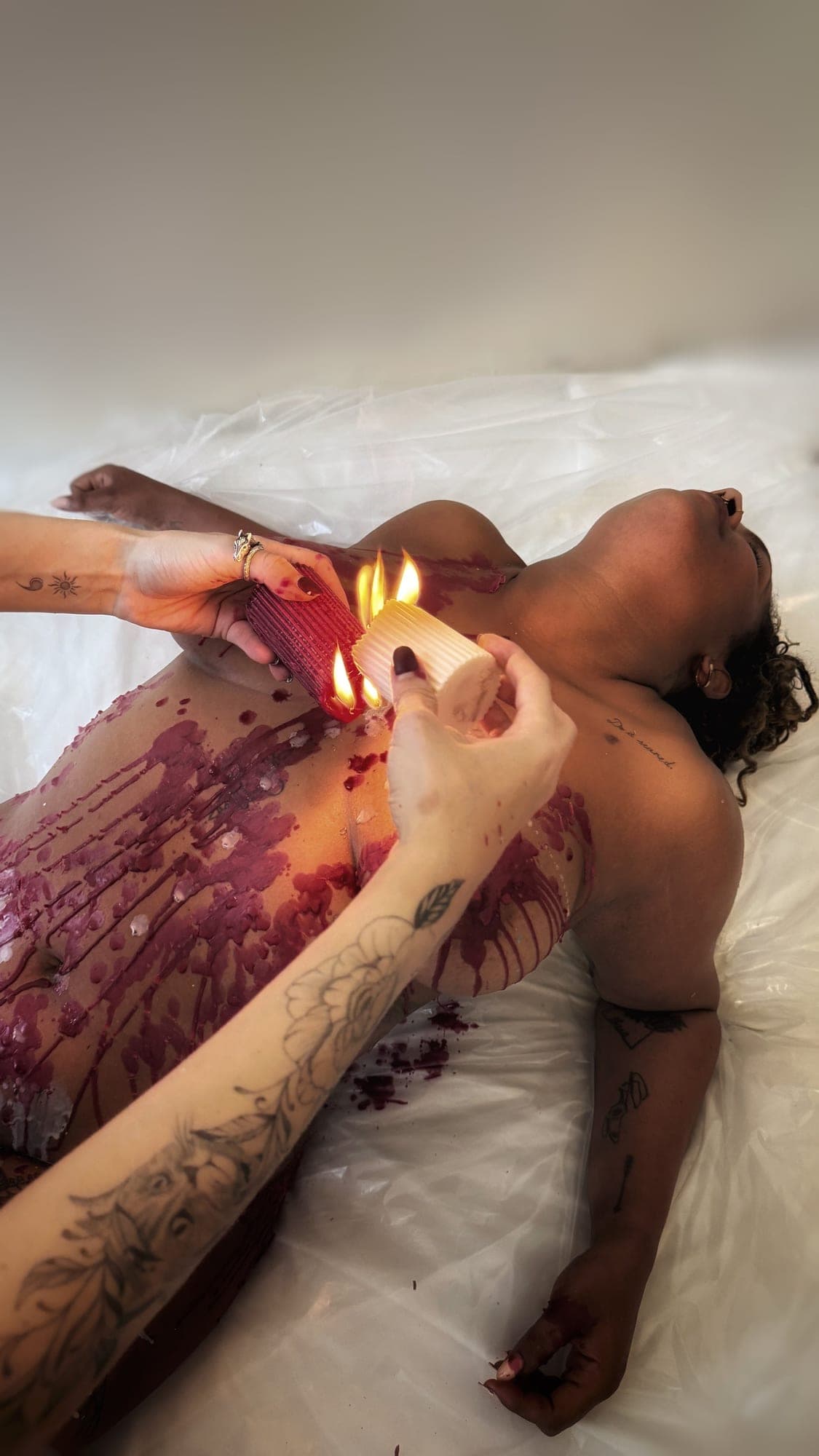
The temperature channel of the map translates directly to any warm-oil or heated-wax practice. Areas that scored high on the temperature channel will produce the strongest response to heated wax at controlled temperatures, warm-oil massage, or warm compresses. Areas that scored low on the temperature channel are better suited to pressure-based work or texture work; pushing thermal input on a low-response area rarely pays off. The map lets you stop treating the body as uniform and start treating it as a set of regions, each best suited to a particular kind of input. For the specific safety constraints of wax play — where heated wax can and cannot safely go — see the wax play body map guide, which is a different map built for a different purpose.
Pressure and Stroke Work
Pressure-sensitive areas — often the shoulders, the upper back, the hips, the feet — are where sustained weight and firm contact produce the most settling. These are the areas where co-regulation touch lands most strongly, and where pressure-based techniques (firm hands, weighted blankets, sustained holds) outperform stroke-based ones. Stroke-sensitive areas — often the inner forearms, the sides of the neck, the inner thighs, the lower belly — respond better to slow, light, sustained movement, where the C-tactile pathway is most active.
The Map As A Shared Document
For couples, the map is most useful when both partners know it. Many couples who have done partnered mapping report that the map becomes a reference across later intimate practice — "left shoulder, sustained pressure, she responds there," "right inner wrist, slow stroke, he settles there." What the map replaces is the old strategy of guessing. For a broader set of sensation-based couples practices that can be structured around the information a map reveals, see our couples intimacy exercises guide.
Further Reading
- How Touch Changes the Body: A Sexologist's Guide to Sensory Intimacy — the pillar article for this cluster.
- Mindful Touch: How Intentional Sensation Practices Rewire the Nervous System
- Temperature and the Nervous System: Why Warmth Changes How You Feel
- Nervous System Co-Regulation: How Partners Calm Each Other Through Touch
- Intimacy Exercises for Couples: Sensation-Based Practices That Actually Work
- The Vulnerability Window: Why Intense Experiences Build Trust Between Partners
- Wax Play Body Map and Safe Zones — the companion safety guide for wax play specifically.
- Wax Play Temperature Guide: How Each Degree Changes the Experience
Sources & References
- Mancini, F., Bauleo, A., Cole, J., Lui, F., Porro, C. A., Haggard, P., & Iannetti, G. D. (2014). Whole-Body Mapping of Spatial Acuity for Pain and Touch. Annals of Neurology, 75(6), 917–924. — Systematic mapping of tactile and nociceptive spatial resolution across the body surface.
- Weinstein, S. (1968). Intensive and Extensive Aspects of Tactile Sensitivity as a Function of Body Part, Sex, and Laterality. In D. R. Kenshalo (Ed.), The Skin Senses (pp. 195–222). Charles C. Thomas. — Classic reference for two-point discrimination thresholds across body regions.
- Penfield, W., & Rasmussen, T. (1950). The Cerebral Cortex of Man: A Clinical Study of Localization of Function. Macmillan. — Origin of the somatosensory homunculus and the cortical representation of body surface.
- McGlone, F., Wessberg, J., & Olausson, H. (2014). Discriminative and Affective Touch: Sensing and Feeling. Neuron, 82(4), 737–755. — C-tactile afferent distribution and velocity-tuned affective touch processing.
- Ackerley, R., Wasling, H. B., Liljencrantz, J., Olausson, H., Johnson, R. D., & Wessberg, J. (2014). Human C-Tactile Afferents Are Tuned to the Temperature of a Skin-Stroking Caress. Journal of Neuroscience, 34(8), 2879–2883. — Documents the temperature dependence of C-tactile responses, relevant to combined touch-and-temperature practice.
- Corniani, G., & Saal, H. P. (2020). Tactile Innervation Densities Across the Whole Body. Journal of Neurophysiology, 124(4), 1229–1240. — Contemporary quantitative map of mechanoreceptor density across body regions.
This article is for educational purposes and does not constitute medical, psychological, or therapeutic advice. If sensory mapping surfaces trauma responses — persistent flinch, dissociation, or distress — a somatic or trauma-informed therapist is the appropriate support.
Frequently Asked Questions
Can you map your own body alone?
How does sensory mapping connect to wax play and other intimate practices?
How often should you do sensory mapping?
What if an area is numb or produces a flinch?
What is sensory mapping?
What is the difference between sensory mapping and the wax play body map?
Why do different body areas feel different from each other?
Olga Bevz
Olga studies how the body processes sensation in intimate contexts. She founded SenseMe to build tools — specifically temperature-controlled body-safe candles — for people who want to use that science intentionally. She writes about touch, temperature, nervous-system regulation, and the quiet skills that make intense experiences land well.
Read full story