
Mindful TouchHow Intentional Sensation Practices Rewire the Nervous System
The same touch, received with attention, produces a different physiological event than the same touch received while distracted. Attention is not commentary on the experience — it is part of what the experience is. Mindful touch is the practice of learning to put attention where sensation is happening, and letting the body discover what it has forgotten it can feel.

Key Takeaways
- Mindful touch is a structured practice in which attention is deliberately placed on the sensation of touch as it happens, without commentary or goal. It is distinct from massage (which aims to relieve tension), from sexual touch (which aims toward arousal), and from casual touch (which is usually half-attended). Mindful touch aims at one thing: being present with what the body actually feels.
- Attention changes the physiology of touch. Brain imaging shows that the same tactile stimulus produces stronger activation in the insular cortex and somatosensory regions when the receiver is attending to it than when distracted. The subjective experience follows: attended touch feels warmer, more detailed, more emotionally present. This is why a fifteen-minute touch practice with full attention produces more nervous-system shift than an hour of distracted contact.
- Interoception — the sense of the body's internal state — is trainable. People differ markedly in how accurately they can feel their own heartbeat, breath, temperature, and sensation. Mindful touch is one of the most direct ways to build this capacity, and higher interoceptive accuracy predicts better emotional regulation, better recovery from stress, and richer sensory-intimate experience.
- Both solo and partnered practice work. The solo version rebuilds the nervous system's relationship with its own body and is the foundation. The partnered version adds co-regulation and shared attention, and is the bridge between mindful touch and intimate practice. This guide provides step-by-step protocols for both.
- Tools support but do not replace the practice. Warm oil, body-safe wax, and scent can make the sensation easier to attend to, particularly in the early stages. But the practice is attention, not the tool. A single warm hand on the skin, received fully, does more than any elaborate setup received half-attended.
Mindful touch is a specific practice: placing attention on the sensation of physical contact as it happens, without evaluating it, comparing it to other touches, narrating it internally, or steering it toward any outcome. It borrows from the long tradition of mindfulness meditation — the same tradition that produced body-scan practice, loving-kindness meditation, and present-moment awareness training — but centers the practice on the tactile sense rather than on the breath or on thought.
The reason this matters, and the reason it has become an established tool in somatic therapy and sex therapy, is that attention is not a passive lens on experience. Attention changes the experience at the level of nervous-system activation. The same touch, attended to fully, produces different brain activity, different autonomic shifts, and a different subjective report than the same touch received while the receiver is thinking about the grocery list. For people whose relationship with their own body has become muted — through chronic stress, trauma history, long cognitive work, or simply a life in which sensation was never the point — mindful touch is the most reliable way to bring sensation back into the foreground.
I am Olga Bevz, a sexologist. I design tools for intentional sensation — oils, body-safe candles, aftercare products — and mindful touch is the underlying skill that makes all of them work better. This guide covers what the practice is, the neuroscience of why attention changes sensation, a solo protocol, a partnered protocol, the tools that support the work, and the common challenges that come up when people start.
What Is Mindful Touch?
Mindful touch is defined by what it is not as much as by what it is. It is not massage: there is no target muscle, no tension to release, no outcome to produce. It is not sexual touch: arousal may or may not arise, but it is not the aim. It is not self-soothing in the casual sense — stroking your own arm while watching TV — because the defining feature is full attention. What is left after those subtractions is a narrow thing: contact between a hand and a body, and a mind that stays with the contact.
The instructions are simple. A hand moves slowly across a section of skin. The receiver attends to the sensation at the point of contact — the temperature, the texture, the pressure, the direction of movement. When attention drifts to thought, it is brought back to the sensation without judgment. When the touch produces emotion — comfort, discomfort, memory, numbness, arousal — the emotion is noticed and attention returns to the sensation. The entire practice is that loop: contact, attention, notice, return. Fifteen minutes of this produces more nervous-system shift than most people expect.
This is not a ceremony. It is closer to a training exercise for the somatic portion of the mind. The reason mindful-touch practices appear in somatic therapy (Levine, Ogden), in sex therapy (Nagoski, Perel), and in mindfulness-based clinical work (Kabat-Zinn) is the same: they reliably produce measurable improvements in interoceptive accuracy, emotional regulation, and sensation-based pleasure. The dosage matters. Once is an introduction. A regular practice — fifteen minutes, three to five times a week, for several weeks — produces changes in how the nervous system processes sensation more broadly, including in contexts outside the practice itself.
The Neuroscience of Attention and Sensation
Why Attention Amplifies Touch
When a tactile stimulus reaches the skin — a stroke of a warm hand, the weight of a blanket, the drip of warm oil — the signal travels through the somatosensory system into the primary somatosensory cortex (S1) and onward into the insular cortex, where tactile information is integrated with emotional and bodily-state processing. What attention does, measurably, is increase the signal-to-noise ratio of this pathway. Functional-MRI studies show that attended touch produces stronger activation in S1 and in the pregenual anterior cingulate cortex — a region closely tied to affective touch — than the same touch received under distraction. The stimulus does not change; the brain's response to it does.
The subjective consequence is that attended touch feels more detailed, warmer, and more emotionally present. Distracted touch feels generic. This is why people sometimes report that a long massage they half-experienced while thinking about work produced almost no effect, while five minutes of attending to a warm hand on the chest in a quiet room produced a distinct shift. The amount of time is not the variable. The quality of attention is.
Interoception: Feeling the Inside of Your Body
Interoception is the sense of the body's internal state — the awareness of heartbeat, breath, temperature, hunger, visceral tension, and the broad category of "how your body is right now." It is a distinct sense, not a derivative of other senses, and it is mediated by the insular cortex. People vary significantly in their interoceptive accuracy: some can feel their own heartbeat with high precision, detect small shifts in breath, and notice emotion as bodily sensation before naming it cognitively. Others have a muted interoceptive signal — the body reports its state only in coarse increments, and subtle signals are missed entirely.
Interoceptive accuracy is trainable. The most direct training is attention — specifically, repeated episodes of placing attention on bodily sensation and staying with it long enough for the insular cortex to update its maps. Mindful touch is one of the best-studied vehicles for this because touch provides a clear, continuous, locatable signal that attention can land on. Body-scan meditation and co-regulation practices work similarly. The practical payoff of higher interoceptive accuracy is significant: better emotional regulation (you feel the beginning of an emotion rather than being hit by its climax), faster recovery from stress, more accurate recognition of hunger, fatigue, and arousal signals, and a richer experience of any sensation-based practice.
A Solo Mindful Touch Practice (Step-by-Step)
This is the foundation practice. Fifteen minutes, alone, in a quiet room. Done three to five times a week for four to six weeks, it produces a measurable change in how the nervous system processes sensation. The materials are minimal: a small amount of oil (jojoba, sweet almond, or a body-safe oil), a warm room, and the ability not to be interrupted.
- Prepare the room. Warm, dim, no screens, no phone within reach. Temperature matters: a cool room works against the parasympathetic shift you are trying to produce. If necessary, run a warm shower first so your skin starts warm.
- Sit or lie comfortably. Clothing off or loose. Do a thirty-second settling breath: four counts in, six counts out, three or four rounds. Do not force relaxation — the body will settle if the conditions are right.
- Warm the oil between your hands. A few drops, rubbed between the palms until the oil is at skin temperature. This step matters: cold oil produces a sympathetic startle that works against the practice. Warm oil communicates safety from the first contact.
- Begin with the forearms. Place one oiled hand on the opposite forearm. Move slowly — roughly an inch per second, no faster. This velocity matters: C-tactile afferents, the nerve fibers that carry affective touch signals, fire most strongly at this speed.
- Attend to sensation at the point of contact. Not to the whole room, not to your thoughts about the touch — to the actual sensation where your hand meets skin. Temperature, texture, pressure, the direction of movement, the slight drag of oil. When attention drifts, notice the drift and bring attention back. The bringing-back is the practice, not a failure of it.
- Move outward progressively. After two or three minutes on one forearm, move to the other forearm, then the hands and palms, then up to the shoulders and neck, then the chest and ribs, then the abdomen, then down to the thighs, calves, and feet. Spend one to two minutes on each area. Cover the body you can reach, slowly.
- Notice emotion without chasing it. Some areas will produce memory or emotion — grief, tenderness, discomfort, arousal, numbness. All of these are signals, not problems. Notice the emotion, stay with the sensation, and continue the touch at the same pace. Do not speed up to move past discomfort, and do not stop to process the emotion with words. The body integrates without language if you let it.
- End with stillness. When you have worked through the body, stop. Rest with both hands on the chest or belly for two minutes. Breathe slowly. Let the nervous system finish settling before you stand up. This is the equivalent of aftercare for a solo practice — skipping it truncates the benefit.
A Partnered Mindful Touch Practice (Step-by-Step)
The partnered version adds co-regulation and shared attention. It is not a prerequisite of the solo practice, but it is a natural progression for couples who want to build their sensation-based intimacy on a solid foundation. Thirty minutes, one person giving, one receiving. Switch roles in a later session — do not combine both in one sitting, because it collapses the practice into reciprocation rather than attention.
- Negotiate before touch begins. Agree on the time length, the parts of the body in scope, and a signal for pause or stop. Agree that the practice is non-sexual — this removes the drift toward arousal that otherwise crowds out attention. Agree that no conversation is needed during the practice itself.
- The receiver settles first. Lie down, clothing off or loose, in a warm room. Close the eyes. The giver places one hand on the chest or shoulder and waits, not moving, for thirty seconds or more. This is the co-regulation start: the receiver's nervous system orients to the giver's presence and begins to synchronize.
- The giver begins with a clear first stroke. Warm oil between the hands first. The first stroke should be unhurried and distinct — long, slow, covering a defined area (forearm, shoulder, outer thigh). Speed: about one inch per second. Pressure: firm enough to be felt clearly, light enough not to demand muscular response.
- Both partners attend to the same sensation. The giver attends to what they are doing — the texture of skin, the warmth under their hand, the feedback of the receiver's breath. The receiver attends to what they are receiving — where the hand is, the temperature, the movement, any emotion that arises. The shared attention is what makes this different from a massage.
- Work through the body slowly. The giver covers the agreed areas — forearms, hands, shoulders, back, chest (if in scope), abdomen (if in scope), legs, feet. Two or three minutes per area. No talking. If an emotion surfaces in the receiver, the giver does not stop; they continue at the same pace. If a pause is needed, the receiver signals and the giver rests with stillness until the receiver indicates continuing.
- End with sustained stillness and then talk. When the touch portion ends, the giver rests both hands on the receiver's chest or abdomen for three to five minutes in silence. Then, if wanted, a slow conversation about what was felt. The conversation is aftercare: it completes the arc. Skipping it leaves the practice unfinished. The conversation does not need to be long or analytical — a few sentences about what came up, or what felt particularly present, is enough.
Tools That Support the Practice
Mindful touch does not require tools. A bare hand on bare skin is sufficient. But tools can make the sensation more attention-grabbing in the early stages of practice, when attention is still being trained and bare touch can feel too subtle to hold onto. Three categories of tool are worth naming.
Temperature (Warm Oil, Body-Safe Wax)
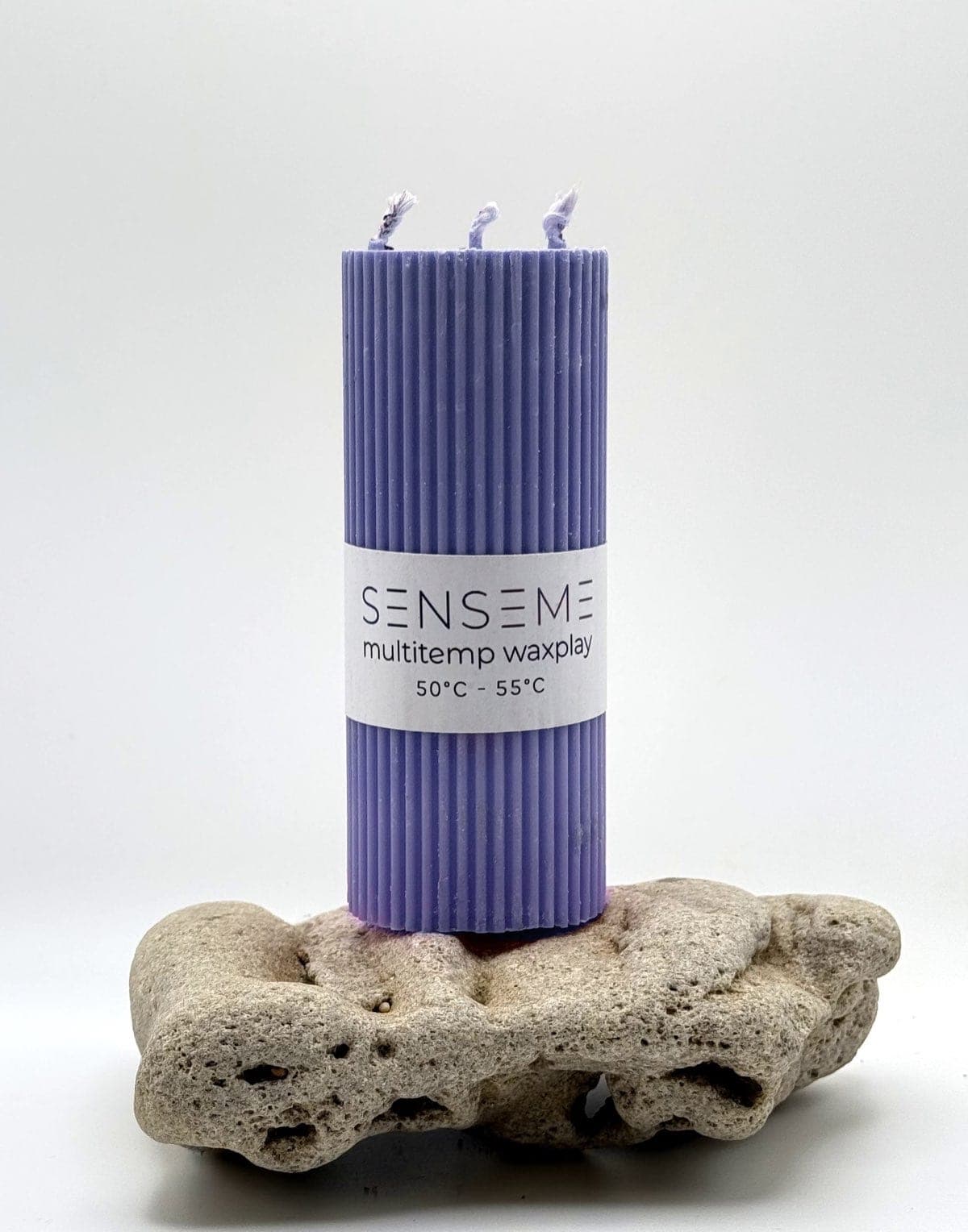
Warm oil, the simplest addition, amplifies the tactile signal by combining it with thermal input. The thermal channel runs through a partially separate pathway in the nervous system, and the combination reaches the brain as a richer sensory event than tactile input alone. This makes attention easier to sustain — there is more to attend to. Body-safe candles at 50–55°C produce a more focused version of the same effect: a precise application of warmth at a known temperature, which is useful as people progress from warm oil toward structured sensation work.
Texture
Different textures produce different activation patterns in the skin's mechanoreceptors. Silk, wool, a cool metal object, a soft brush — each produces a distinct sensation that is easier to attend to than a repeated hand stroke. Alternating textures within a session, or using a texture as a contrast after oiled-hand work, can refresh attention when the receiver's nervous system starts to habituate. Variety in texture is not about novelty for its own sake; it is about keeping the sensation in the foreground of awareness.
Scent
Scent interacts with touch at the brain-integration level — the olfactory system feeds directly into the limbic system and the insular cortex, where touch signals are also being processed. A mild, pleasant scent in the room (not applied to skin) deepens the emotional register of the practice without demanding separate attention. For a detailed exploration of scent and nervous-system state, see our companion article on how scented candles change the mood.
Common Challenges and How to Handle Them
"My mind wanders constantly." This is the practice. Attention wanders; you bring it back to the sensation. The bringing-back is not a failure — it is the training movement. A session in which attention wanders fifty times and is brought back fifty times is a successful session. The quality sharpens over weeks, not within a single session.
"I feel nothing." Numbness is common in early practice, especially for people whose interoceptive signal is low. The fix is not to push harder for sensation. The fix is to slow down further — move even more slowly, attend to even smaller sensations (the temperature of the oil, the faint drag of skin on skin), and extend the practice window. Numbness fades as the insular cortex updates its maps. It takes weeks, not days.
"Strong emotion surfaced and I stopped." Emotion surfacing is a signal of the practice working — the body is releasing what it has been holding. Stopping at the first wave of emotion teaches the nervous system that emotion is a problem, which works against the purpose. The guidance is: continue the touch at the same pace, breathe through the emotion, and let it move. If the emotion is truly overwhelming — not just intense — pause, rest, and resume a shorter version the next day. For grief or trauma that repeatedly surfaces, work with a somatic or trauma-informed therapist alongside the practice.
"It felt sexual and I was not expecting that." Sensation and arousal share neural pathways; a mindful touch practice can produce arousal even when it is not the aim. This is not a problem. The practice is to notice the arousal as sensation — the same way you would notice warmth or pressure — without steering the session toward it or away from it. If the arousal becomes a distraction that crowds out attention, ending the session there is fine. The practice is not ruined.
Further Reading
- How Touch Changes the Body: A Sexologist's Guide to Sensory Intimacy — the pillar article for this cluster.
- Touch Hunger: What Happens When the Body Does Not Get Enough Physical Contact
- Oxytocin and Touch: The Biology of Bonding, Trust, and Connection
- Temperature and the Nervous System: Why Warmth Changes How You Feel
- Nervous System Co-Regulation: How Partners Calm Each Other Through Touch
- Intimacy Exercises for Couples: Sensation-Based Practices That Actually Work
- Best Oils for Body Care and Aftercare
Sources & References
- Craig, A. D. (2009). How Do You Feel — Now? The Anterior Insula and Human Awareness. Nature Reviews Neuroscience, 10, 59–70. — Foundational account of the insular cortex as the seat of interoceptive awareness.
- Farb, N. A., Segal, Z. V., Mayberg, H., Bean, J., McKeon, D., Grafton, S., & Anderson, A. K. (2007). Attending to the Present: Mindfulness Meditation Reveals Distinct Neural Modes of Self-Reference. Social Cognitive and Affective Neuroscience, 2(4), 313–322. — Demonstrates that attention training produces measurable shifts in how the brain processes bodily experience.
- Lindgren, L., Westling, G., Brulin, C., Lehtipalo, S., Andersson, M., & Nyberg, L. (2012). Pleasant Human Touch Is Represented in Pregenual Anterior Cingulate Cortex. NeuroImage, 59(4), 3427–3432. — Neural correlates of affective touch and their enhancement under attention.
- McGlone, F., Wessberg, J., & Olausson, H. (2014). Discriminative and Affective Touch: Sensing and Feeling. Neuron, 82(4), 737–755. — The C-tactile afferent system and the velocity-dependence of affective touch processing.
- Mehling, W. E., Price, C., Daubenmier, J. J., Acree, M., Bartmess, E., & Stewart, A. (2012). The Multidimensional Assessment of Interoceptive Awareness (MAIA). PLOS ONE, 7(11), e48230. — Validated measurement of interoceptive accuracy and its trainability.
- Kabat-Zinn, J. (2013). Full Catastrophe Living: Using the Wisdom of Your Body and Mind to Face Stress, Pain, and Illness (Revised ed.). Bantam. — Clinical foundation of mindfulness-based practices, including body-scan protocols that share mechanism with mindful touch.
This article is for educational purposes and does not constitute medical, psychological, or therapeutic advice. If mindful touch practice surfaces trauma symptoms that feel unmanageable, a licensed somatic or trauma-informed therapist is the appropriate support.
Frequently Asked Questions
Do I need special tools for mindful touch practice?
Does attention really change how touch feels?
How long should a mindful touch session be?
Is mindful touch sexual?
My mind wanders constantly during practice — am I doing it wrong?
What is interoception and why does it matter?
What is mindful touch?
Olga Bevz
Olga studies how the body processes sensation in intimate contexts. She founded SenseMe to build tools — specifically temperature-controlled body-safe candles — for people who want to use that science intentionally. She writes about touch, temperature, nervous-system regulation, and the quiet skills that make intense experiences land well.
Read full story